I'm not a doctor, so you definitely shouldn't treat this as medical advice. This is just me reflecting on my experience and listing things I wish I knew before and after my ACL reconstruction surgery.
Whether to get the surgery or not?
Get it! The people - both patients and doctors - I spoke to were divided into two camps: those who recommended the surgery and those who advised against it. Luckily, the majority opinion was the right one. Unless you're older or unable to give adequate time to post-op recovery, it's a no-brainer. Get the surgery.
What should I do before the surgery?
Strengthen your muscles! People warned me that the quadriceps and hamstrings in the affected leg would atrophy, but I was unprepared for the extent to which my thighs lost mass and strength. My consulting ortho recommended a few exercises even before the surgery, and I wish I had done more of those. Of course, this advice depends on your unique situation. Since I only had a 3-week gap between my injury (which included a medial meniscus tear) and the operation, I could only do the exercises for about a week or so. But in general, the stronger your thighs are before the surgery, the better prepared you are for recovery post-surgery.
What should I ask my doctor about the surgery?
From my research, it appears that the surgeon's main decision is to pick between one of three types of grafts: hamstring, patellar tendon, or an allograft (from a cadaver). If you're young, you should definitely choose the hamstring graft.
What should I know about the recovery process?
Not discounting the importance of a skilfully executed surgery, but most outcomes are eventually determined by the quality of the physiotherapy that follows. I happened to be on a sabbatical and was able to dedicate significant time to physiotherapy, which hastened my journey back to normalcy. Here are the rough milestones my surgeon and physio set for me:
Week 1 & 2 - Full extension: The first goal for rehab was to fully extend my knee. Since I had torn my meniscus too when I tore my ACL, the surgeon was a little conservative in the first two weeks. In most other cases, the doc is likely to encourage you to start flexing your knees too from day 2 or 3.
Week 3 & 4 - 90° flexion: The exercises were still fairly mild at this time, focusing on sitting on a chair with knees flexed at right angles.
Week 5 & 6 - 130° flexion: It felt like I hit a wall by the time I reached 90 degrees, as arthrofibrosis had set in. The regime intensified, and this was the most painful part of the process. The physiotherapist applied force to increase flexion by about 5 degrees daily. The knee would be inflamed and needed icing, but the next morning, there was no pain. This is when I realized the value of a good physiotherapist. The force applied should be calibrated to make daily progress while allowing recovery for the next day's session.
Week 7 & 8 - Full range of motion: The physiotherapist focused on rebuilding lost strength in the thighs and worked on reaching full knee flexion. Sitting in vajrasana and in the Indian toilet squat positions, each for about 20 minutes a day, helped ease the knee into its full range of motion. It was still painful, though. I also started cycling in this period, which helped introduce cardio back into the mix and kept the knees oiled for physio.
Week 9 & 10 - Strengthening: Therapy shifted to the gym, focusing on strengthening all muscles in the thigh and calf. Seated and laying leg curls, squats, leg press, and workouts on the hip abductor machine were emphasized.
Week 11 & 12 - Balance: Balance and stability exercises were added, involving catching a medicine ball while standing on a wobble board and later on a hedgehog balance pod. We continued all exercises from weeks 7 to 10.
Week 13 & 14 - Running: I felt comfortable trying to run by week 13. The first few runs were painful. Even beyond that, I always had to endure discomfort during the first kilometer and then slowly ease into a rhythm. Running was the most effective in bringing back strength, although all gym exercises helped bring back muscle tone in the leg.
At this point, I feel confident about working my way back into sports drills like soccer ball dribbling or basketball layups. It will take a few more weeks before I can fully take my knee for granted and go back to contact sports, but the journey so far, like all arduous ones, has been totally worth it, most of all for the mindfulness it has brought to my physical activities.
Friday, September 29, 2023


Thursday, September 21, 2023
Ellora


Ellora has a series of rock-cut excavations built over a period of nearly 500 years, starting around the 6th century CE. The end result is a series of 34 caves representing three great traditions of pre-Islamic India—Buddhism, Jainism, and Brahmanism—that were healthily jostling for civilizational mindspace in that period. The first twelve caves, also the oldest ones, are Buddhist in nature and reminiscent of the Ajanta caves. The last five represent Jainism, somewhat similar to the Buddhist ones, but most Indians will identify the Jain motifs in the exquisite details. Almost as a symbol of the hegemony that Brahmanism eventually claimed in this land, the middle caves are dominated by the Hindu excavations.
Most of the 16 caves in the middle section are special in their own way, and I realized the single day I had budgeted for Ellora was woefully inadequate. Cave 15, for instance, depicts the Dashavatara, and each carving is a story unto itself. But the real showstopper is cave 16, the Kailasa temple.

Wednesday, September 20, 2023
Ajanta

Picture a horse-shoe shaped valley thick with vegetation enclosed by a near-vertical rock face. One end of the horse-shoe is a seven-stepped waterfall that then leads to a stream running right through the valley. On the cliff are caves that have been engraved into the rock which served both as viharas - resting areas - as well as places of worship and ceremony. The caves still have intricate carvings inside and at their peak, over a millenium and a half ago, would also have contained spectacularly executed wall paintings, some of which have survived even to the present day despite being exposed to the elements. The setting seemed like the work of an overzealous art director working in a big-budget south indian movie, and yet there it was before my eyes.

It made me think about what this valley would have looked like in its heyday. It made me contemplate the power of a school of thought that drove people to literally reshape mountains. It made me wonder about the level of scientific knowledge and sophistication that enabled people to plan and execute such architectural marvels that look set to last a few more millenia.

I came away also with the appreciation of how well the monuments have been preserved too. Their designation as UNESCO heritage sites may have something to do with the level of preservation. Visiting the monument on a cloudy day with only a thin weekday crowd in attendance, and the previous week's rains having fed the streams and perked up the vegetation, may have heightened my experience but very few places compare with Ajanta.
Thursday, August 31, 2023
The Power of the Ordinary Moment
At the start of my sabbatical in Apr ‘23 I was just finishing reading a book called The Power of Moments which extolled the ‘extraordinary impact of certain moments’. The book served as a how-to guide for creating such so-called peak moments. Looking back, that’s probably how I envisioned my sabbatical to be - a thoughtfully choreographed string of peak moments. And then in a fateful instant I tore my ACL and had to throw the itinerary in the trash can. The surgery that followed was probably also a peak moment, but not the kind the book had in mind.
Cut to nearly four months later, and I’m in the middle of the rehabilitation to bring my knee back to full function. The journey towards normalcy has been physically quite painful, and at times, mentally draining, but there is a silver lining if you care to look for it. An injury of this nature, i.e. any that’s not permanently debilitating, can really make one rediscover the magic in perfectly ordinary moments. It was such a thrill to first drop the knees down to a ninety degree angle. And then every ten degrees of flexion from there on was a celebration each. Being able to climb the stairs, and then later climb down without support, the first bicycle ride, the first Vajrasana, the first skip; all champagne-worthy. They were all quite painful to be sure, but somehow the pain didn’t get committed to memory. Only the elation did.
I’m only human and I’m fairly sure I’ll go back to taking normalcy for granted and chasing peak experiences once again, but I do wish there was a way to keep alive this gratitude that I feel for being able to do the mundane things. Even if I can retain a small proportion of this appreciation the injury wouldn’t have been in vain.
Cut to nearly four months later, and I’m in the middle of the rehabilitation to bring my knee back to full function. The journey towards normalcy has been physically quite painful, and at times, mentally draining, but there is a silver lining if you care to look for it. An injury of this nature, i.e. any that’s not permanently debilitating, can really make one rediscover the magic in perfectly ordinary moments. It was such a thrill to first drop the knees down to a ninety degree angle. And then every ten degrees of flexion from there on was a celebration each. Being able to climb the stairs, and then later climb down without support, the first bicycle ride, the first Vajrasana, the first skip; all champagne-worthy. They were all quite painful to be sure, but somehow the pain didn’t get committed to memory. Only the elation did.
I’m only human and I’m fairly sure I’ll go back to taking normalcy for granted and chasing peak experiences once again, but I do wish there was a way to keep alive this gratitude that I feel for being able to do the mundane things. Even if I can retain a small proportion of this appreciation the injury wouldn’t have been in vain.
Monday, April 03, 2023
Punakha
Our third stop on the Bhutan trip was Punakha, the site of one of Himalayan Buddhism's grandest monuments, the eponymous Punakha Dzong. Getting to Punakha requires you to climb over 3100m past Dochula, where we got to do the trip's first birding session behind a cafe where we stopped for our morning coffee.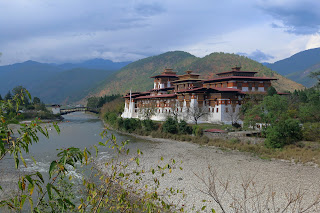
Punakha, as the legend goes, is where the 16th century hero Zhabdrung set up his stronghold against Tibetan marauders and eventually unified the Bhutanese people under one flag. That, at least, is what I gathered from our guides telling of the history, which effortlessly mixed fact and legend into one fascinating tale. The fortress, or dzongka, by far the most magnificent we encountered on this trip is situated at the confluence of two rivers Pho Chhu and Mo Chhu, which are said to be male and female respectively.

Punakha, as the legend goes, is where the 16th century hero Zhabdrung set up his stronghold against Tibetan marauders and eventually unified the Bhutanese people under one flag. That, at least, is what I gathered from our guides telling of the history, which effortlessly mixed fact and legend into one fascinating tale. The fortress, or dzongka, by far the most magnificent we encountered on this trip is situated at the confluence of two rivers Pho Chhu and Mo Chhu, which are said to be male and female respectively.
The trip to Punakha also included a nice hike up to a temple dedicated to the fourth king of Bhutan. To top it all off we stayed at a hotel right by the river bank (of the tempestuous female one), watching tens of species of birds right from the room windows.
Sunday, April 02, 2023
Searching for Happiness in Thimphu

From the moment you land in Bhutan there are constant reminders of this country’s smugness about achieving happiness for its citizens. All the souvenir shop trinkets talk about Gross National Happiness. How exactly does one go about increasing this metric? All through my time at Thimphu I kept wondering about this question to see if there are easy answers and takeaways.
At the surface, many things about Bhutan seem first-worldish. The urban planning clearly is more evolved than in our country. The building codes seem to enforce some common architectural motifs - like the use of traditional window frames - that give the cities a harmonious feel, unlike the chaos of our own hill towns. The road infrastructure seemed adequate, and the people using it seemed exceptionally well-mannered. Drivers seemed to strictly adhere to lane discipline and I didn’t hear a single honk in my entire time at Thimphu. In fact, I even learned that there are no traffic lights in the whole of Bhutan. Only one intersection in the city is deemed complex enough to necessitate a traffic policeman directing traffic, making it such a novelty that people stop and take pictures of the officer (and thus complicating the flow of traffic in the process). The annual per-capita GDP is nearly a thousand dollars more than in India, and you can sense that relative prosperity in some ways. There is no sign of abject poverty even in the biggest cities. The only visibly poor people I saw were migrant workers from India. I did ask a few people (by which I mean our driver and a couple of our guides) about what makes Bhutan happier than other countries, and their answers didn’t indicate any silver bullet. They all seemed to view the royal family very favourably, and they talked about free education and healthcare at all times, and about how the government helped them out with handouts during the pandemic. They all seemed especially proud of their culture and heritage.
In the end I don’t know if there are easy takeaways. To my eyes, people in the Himalayas seem, on average, happier than the rest of us. The people especially in the Buddhist belts (Ladakh and Sikkim definitely, and parts of Arunachal) seem even happier. Maybe it comes with having a benevolent ruler. Maybe it's to do with being a small nation with relative cultural homogeneity. Or maybe the slogan itself - “Gross National Happiness”- serves as a self-fulfilling placebo, as opposed to more negatively worded ones like Garibi Hatao. Whatever the reason, Thimphu did seem like a happy place and it really set the tone for the rest of the trip
At the surface, many things about Bhutan seem first-worldish. The urban planning clearly is more evolved than in our country. The building codes seem to enforce some common architectural motifs - like the use of traditional window frames - that give the cities a harmonious feel, unlike the chaos of our own hill towns. The road infrastructure seemed adequate, and the people using it seemed exceptionally well-mannered. Drivers seemed to strictly adhere to lane discipline and I didn’t hear a single honk in my entire time at Thimphu. In fact, I even learned that there are no traffic lights in the whole of Bhutan. Only one intersection in the city is deemed complex enough to necessitate a traffic policeman directing traffic, making it such a novelty that people stop and take pictures of the officer (and thus complicating the flow of traffic in the process).

In the end I don’t know if there are easy takeaways. To my eyes, people in the Himalayas seem, on average, happier than the rest of us. The people especially in the Buddhist belts (Ladakh and Sikkim definitely, and parts of Arunachal) seem even happier. Maybe it comes with having a benevolent ruler. Maybe it's to do with being a small nation with relative cultural homogeneity. Or maybe the slogan itself - “Gross National Happiness”- serves as a self-fulfilling placebo, as opposed to more negatively worded ones like Garibi Hatao. Whatever the reason, Thimphu did seem like a happy place and it really set the tone for the rest of the trip
The Paro Festival


The setting was the remarkable dzong at Paro. Streams of visitors - women in their colorful Kiras and the men in their stately Ghos - poured into the courtyard of the fortress, which was going to host a famous ritual called the Mask Dance this afternoon. As stunning as the spectacle was visually, there definitely was a cultural barrier that came in the way of appreciating the performance. The music didn’t seem particularly striking. The dance moves were underwhelming too. At one point, I thought the policeman in the intersection had more intricate moves than the dancers here. There were a few performers in joker masks that were cracking up the crowd, but of course we couldn’t understand them, even when our guide did his best to translate the jokes for us. The local audience, though, was lapping it up, and we were left to feed off their excitement. All said and done, we were glad for the serendipity that led us here, and we felt we were genuinely taking away an experience that was like nothing other.
Saturday, April 01, 2023
Arriving in Bhutan
We might share a land border with Bhutan but getting here is not easy. We boarded our flight to Paro after enduring a nightmarishly long checkin and immigration process at Delhi airport, and what should have been a 2-hr flight took us at least thrice as long. We approached the Paro airport on schedule but since the weather didn’t allow a landing there we were re-routed to Bagdogra airport back in India, where we stood on the runway waiting for the distant clouds to clear up. When the weather improved we finally took off . Weaving through the mountains to land on the single runway at Paro we realised why it’s nigh impossible to land here in poor weather. I learned later that only seven pilots are certified to ply their trade at Paro, and landing here is considered one of the riskiest assignments for a commercial pilot. The thrill of the flight aside, it had been a long energy-sapping day, and I suspected that in our mood at that time our family had momentarily brought down the gross national happiness of Bhutan. We cancelled all plans for the day and stayed in at the hotel.
Friday, March 31, 2023
The Sabbatical
“A human being should be able to change a diaper, plan an invasion, butcher a hog, conn a ship, design a building, write a sonnet, balance accounts, build a wall, set a bone, comfort the dying, take orders, give orders, cooperate, act alone, solve equations, analyse a new problem, pitch manure, program a computer, cook a tasty meal, fight efficiently, die gallantly. Specialization is for insects.”
Some time in my teens I remembered reading this quote from a Robert Heinlein character, and something about it snapped in place in my head, and to the best of my limited abilities I’ve tried to do a lot of things despite being aware of the obvious tradeoffs involved in being a jack-of-all. Lately, and especially after the pandemic, I had felt that I was falling behind on all the things I wanted to learn and do. That’s the nagging feeling that prompted the sabbatical that I started in April.
Butchering a hog and dying gallantly are not on the agenda, but I hope to use the next three months to clear my head, work on some precious relationships, and get into the habit of living an examined life. Part of that process also involves writing more often and putting a portion of it in public. The regularity of posts on this blog has dwindled over the years and reading some of my old posts makes me cringe and shudder, but I reckon that is a sign of growth too. Besides, I don’t know any other readers apart from my mom who visit this space. So here I am, putting some more spam into the universe so that I can cringe a few years from now.
Saturday, December 31, 2022
Reading in 2022
This was a year in which I obsessively read history, and so I begin with the books that I really enjoyed.
For almost all of childhood, Cubbon park, the green space adjoining our school, was a big part of growing up. This book below was a short read about the fascinating history of the park and the role it has come to play in the city
I also ended up reading two remarkable memoirs that made a deep impression.
Don't Make Me Think, Revisited - Steve Krug
I read three works of fiction but none made a lasting impression.
This tome took me a while to finish, but it was a fascinating window into how seriously Dr. Ambedkar took his whole exploration into Buddhism.
And finally, some of the other miscellaneous reading I managed to finish.
Consolations - David Whyte
Biology of Belief - Bruce H. Lipton
The Devil in the White City - Erik Larson
Consolations - David Whyte
Biology of Belief - Bruce H. Lipton
The Devil in the White City - Erik Larson
Empire of Pain: The Secret History of the Sackler Dynasty - Patrick Radden Keefe
Parliament of Whores - P.J. O'Rourke
Infinite Powers: How Calculus Reveals the Secrets of the Universe - Steven Strogatz
Parliament of Whores - P.J. O'Rourke
Infinite Powers: How Calculus Reveals the Secrets of the Universe - Steven Strogatz
Monday, August 01, 2022
Vultures of SRS Betta

A few billion years ago huge granite rocks formed under what is now the Deccan plateau. More recently, probably tens of millions of years ago, the granite complex broke through the Deccan traps, forming a geographical structure running north-south all the way from Ramanagara to Hampi. Erosion and other elemental forces played their part to leave dramatic granite rocks all along this area, making it look like the gods played marbles with these massive boulders.
Many such massive monoliths sit close to the Arkavathy valley and one of the famous ones among them is a called the SRS Betta, named after an enterprising mystic who saw a little nook almost at the top of the sheer granite face and said "Hmm that could be a good place to meditate". That nook is now a shrine and attracts hundreds of devotees every week. The authorities have made this shrine accessible by carving out steps on the smooth granite rock face and have lined the path with hand rails. Most other rocks in this area, however, are completely inaccessible and these serve as the perfect nesting place for some of the most enigmatic large birds in this area; the Egyptian vultures.
This weekend, we trekked up the SRS Betta. This was my first time despite having spent long periods of time in this area. As we reached the top and soaked in the fantastic views hot air drafts around the hills started attracting the raptors around. Soon we spotted our usual vulture pair in the mixed flock. This day they had come there with a surprise; there were two juveniles circling around the parents. Just as I was taking this life-affirming sight, a pair of peregrine falcons swooped in from somewhere and attacked the vulture pair. For some reason they kept bothering the juvenile vultures for nearly half an hour, just as the hapless pair were trying to mind their own business and focus on their flying skills.
I had spotted these peregrine falcons for the first time in this area. And I had been reassured that the vulture pair, given their endangered status, had continued the holy mission of bringing new progeny into the world. We eventually came down from the Betta, but for the rest of the weekend, I've been floating on air.
Monday, March 14, 2022
Reading in 2021
Wave after wave of the pandemic hit us this past year, and made it yet another great year for reading. Here are some notable ones from my reading list in 2021.
The book club at work was active this year, which resulted in me reading a lot of fiction that I wouldn't have picked myself.
- The Woman in the Window - A J Finn
- The Invisible Life of Addie LaRue - V E Schwab
- All The Light We Cannot See - Anthony Doerr
And here are the novels that I happened to pick myself. Especially liked the first two in this list.
- Bewilderment - Richard Powers
- Shuggie Bain - Douglas Stuart
- Any Human Heart - William Boyd
- The Godmother - Hannelore Cayre
- No One Is Talking About This - Partricia Lockwood
A friend whose taste in reading I really appreciate gifted this collection of science fiction short stories. Most of them blew my mind away.
Over the last few years I've been trying to include at least one book in my mother tongue. This year Ii managed to read two, and coincidentally by arguably the greatest father-son combo in the history of literature.
And here's the long list of non-fiction titles I managed to get through this year.
The Bronzeback

Watching Bronzeback Tree Snakes is like watching magicians at work. Their near-perfect camouflage makes it almost impossible to spot them when they are up on a tree, especially if they are not moving. I’ve been finding their moulted skin regularly around our house, sometimes several of them together, which tells me we are surrounded by them. Yet I’ve only managed to see them clearly only once or twice, and that too when they were down on the ground. If you are lucky to spot them before they spot you back, you get to follow them as they try to look for cover. And this is when they perform their special trick. They rise up, in a gravity-defying way, reach out to the lowest hanging branch and lift themselves up into the foliage. If your luck continues you will see a gently progressing wave of shaking leaves as the snake travels - or is it “surf - in the foliage. When the wave stops, you inspect the general area and you might find the snake come to rest on a twig, motionless, fully trusting its own camouflage.
Today happened to be a lottery-winning kinda day, because I managed to trace one of these snakes over two trees before it came to rest. The lucky bit was that I also happened to have my camera in my hand. The snake let me take a half dozen pictures before it realised its cover was blown. Like the consummate superhero, it promptly put on its invisibility cloak and disappeared into the foliage.
Tuesday, July 27, 2021
My Sandalwood Teacher
As a farmer, when you choose a crop that’s not meant for the local terrain or climate, nature gives you very strong feedback. No matter how well you take care of the land preparation, or how you add the choicest manure, or how efficiently you control the weeds and pests, your sapling will still conspire to give up on you. Sadly, so much of modern agriculture is about going against the grain of nature and hence dealing with all pains that come with it. On the other end of the spectrum, where a plant species happens to be perfectly suited for the conditions, there is a beauty about the ease - no, inevitability - with which the plant grows. Like this particular Sandalwood tree that grows out of a crack in one of the large rocks on our farm. Probably dropped as a seed by a bird about 10 years ago, the plant has not only made itself at home in an unhelpful little place, but spawned a dozen other saplings of various sizes and ages, which judging by how they’ve thrived, all seem to have inherited the tenacity from their parent.

There are many things to like about the Sandalwood tree. It stays evergreen - and what a beautiful tint of green too - all year around. It seems unaffected by the insects that wreak havoc on our other plants in this season. It’s got a nice symmetrical conical foliage that makes it compete favourably in the aesthetics category against the proverbial poem. It’s not all form either because it supports a robust little ecosystem within and around it. At this time of the year it is covered with tiny flowers that seem to be quite a hit with the bees and other pollinating insects. These nectar-seekers attract the rest of the links in their food chain. There’s a species of spider, for instance, that builds massive webs to cash in on the bug bounty. The spiders in turn attract a whole bunch of sneaky sunbirds that pick off the insects stuck to the web, and I suspect, help themselves to the spiders too.

So the Sandalwood has many virtues, but most of all, the tree is known for its fragrance for which you need to wait for the wood to mature a bit. Sadly, in our own farm we’ll never experience that part of the life cycle because this tree will meet an untimely and tragic end. The fragrance of the wood, and its association with ritual purity in hindu tradition, have made the sandalwood a prized commodity. The economic incentives are so strong that even the nice people around these parts will be tipped over to the dark side. It’s already scripted; in the next couple of years, one of the villagers will trespass into the property, chop the tree off before it has even grown to the right level of hardness and girth, and will sell it off in the black market.
Initially I thought about installing electrified fences and other protection mechanisms for this budding sandalwood grove but that would be going against the grain. I went through grief and anger and those other stages but I now accept the eventuality of losing these trees. That’s the other thing that this tree’s given me, a grudgingly acquired ability to appreciate something and still be detached about it.
Friday, April 16, 2021
The Big Raid
Hollywood has us all believe that when a large animal approaches you, you first realise its presence through the vibrations it causes. Think ripples in the glass of water on your table a few seconds before the beast shows up. After last night, I can debunk that trope with confidence. We were woken up by an elephant last midnight right next to our bedroom window. The CCTV footage confirmed that it had come in to the property a few minutes ago and had treaded around the house noiselessly. What eventually gave its presence away was not the vibrations in the ground but a really poor eating etiquette. The tusker was trying to pick the juiciest mangoes from the top of the tree, and it employed a brute force technique of breaking the branches, sampling the fruits, and then discarding most of them away noisily.
I watched this individual snack around the house for nearly 4 hours, and while it hurt that our trees were getting destroyed, I consoled myself that we had to share the bounties of this land with its original inhabitants. At some point, though, it got close to a bamboo brush that I feel particularly attached to, and apparently that's where I drew my line for the spirit of coexistence. I had to shoo the beast away from there and the only way I could think of in the fuzziness of that night was to flash my torch at the animal. That tactic seemed to work and the tusker chose the nearest point in the fence to get out of our property. Having deftly dealt with the crisis I slept a satisfied man. So I thought! Only in the morning, when I surveyed the far end of the farm did I realise the full extent of the drama of the previous night. At least six elephants had come in to our farm, and in an unfairly lopsided ratio, they had left behind nine breaches in the fence. The damage to our trees and saplings is too long to mention here. They even managed to mangle one of my tarpaulin ponds, presumably because they tried to all take a bath in it.
In the morning, I went looking for my camera trap that I had placed in that area and found it half buried in a ditch. Luckily it had survived the onslaught to tell us how these giants had tried to snuff out the evidence of their heist.
We'll spend the next few days repairing the damage the herd made, and unlike the farmers in my neighbourhood here, I'm probably among the privileged ones who can shake off the financial damage. I'll soon even forget the hassle of fixing the fences and repairing the pond. Watching the elephants make light work of the large tree from 4 (elephant) body lengths away, however, will remain one of the most surreal wildlife encounters I've ever had.
Sunday, January 10, 2021
Reading in 2020
As an introvert most days of the week, I've always favoured a good book even over wholesome social interactions. Expectedly, this period in which the pandemic forced us indoors was good for reading.
Let me start with the book that caused the biggest "viewquake" for me. As a parent, the biggest takeaway from DNA was how little my parenting actually influences a child's eventual personality. Strangely, instead of making me feel helpless the realisation actually made me feel free.
* Blueprint – How DNA Makes Us Who We Are - Robert PlominI came across Jugalbandi in the Seen and the Unseen podcast where the host Amit Verma engaged with the author in a nearly 3-hr conversation on Indian politic's most fascinating pairing - Vajpayee and Advani. Most liberal portraits of these two men tend to paint them as simplistic good and evil pairing. Sitapati's storytelling lends so much more color, nuance and detail to them. Most interestingly, you understand why the combined biography makes sense, because so much of what transpired can only be explained as the result of that peculiar combination. As soon as I finished this book, I picked up the author's other biography of who I believe is India's most underrated Prime Ministers.
* Jugalbandi: The BJP Before Modi - Vinay Sitapati* Half-Lion: How P.V.Narasimha Rao Transformed India - Vinay Sitapati
There was more history in the portfolio this year. The popular caricature of Genghis Khan being an unsophisticated marauding conqueror always ringed false to me. It just didn't make sense that he could stitch together such a large empire without a method to it. This biography filled in those details for me.
Among bloggers that I follow, Scott Galloway is one of my favourite thinkers. Much of what this book has to say was already said in his newsletters and posts, but it was still rewarding to read them together in this collection.
We started a book club in office this year, and I credit my colleagues with introducing me to these books that I probably wouldn't have read otherwise.
My relationship with self-help books has shifted over the years. I held them in contempt in my 20's, consumed them surreptitiously in my 30's, but now I'm a completely unabashed about reading them. Even the not-so-well written books give me a structured way of thinking about various aspects of life, and I can't see the harm from that.
* The Power of Habit - Charles Duhigg
* The Subtle Art of Not Giving a F*ck: A Counterintuitive Approach to Living a Good Life - Mark Manson
* Ikigai: The Japanese Secret to a Long and Happy Life - Hector Garcia & Frances Mirales
Here's the rest of the list from this year.
Here's the rest of the list from this year.
* Caste: The Origins of Our Discontents - Isabel Wilkerson
* Lord of the Flies - William Golding
* Flash Crash: A Trading Savant, a Global Manhunt and the Most Mysterious Market Crash in History - Liam Vaughan
* Apropos of Nothing - Woody Allen
* Never Let Me Go - Kazuo Ishiguro
* Six Easy Pieces: Essentials of Physics Explained by Its Most Brilliant Teacher - Richard Feynman
* Lord of the Flies - William Golding
* Flash Crash: A Trading Savant, a Global Manhunt and the Most Mysterious Market Crash in History - Liam Vaughan
* Apropos of Nothing - Woody Allen
* Never Let Me Go - Kazuo Ishiguro
* Six Easy Pieces: Essentials of Physics Explained by Its Most Brilliant Teacher - Richard Feynman
Saturday, October 17, 2020
The Big Cat
The denizens of Kurubarahalli Doddi - the nearest village from our farm - have had two unplanned feasts in the last couple of months. NN, one of the goatherds in the village, drives his livestock to a part of the local forest that's home to a particularly enterprising leopard. In two separate but eerily similar incidents, the leopard, in broad daylight and right under NN's nose, ambushed the herd and sunk its teeth into one of the goats. In each incident, NN managed to chase the predator, but didn't manage to the save the prey. In this community, when a goat dies the owner reaches out to his network and lines up a bunch of sellers for the meat and negotiates a price with the group. The distress sale usually happens within the two or three villages in this area that are all inhabited by the lambani community, a fascinating people that trace their lineage to a nomadic tribe that descended from the north of India.
We've been hearing about leopards in this area in other contexts too. The person who owns a house on one of the main streets claims to see a leopard from his balcony every other day. One of them even made the leap to his terrace when they had tied their dog there.
All these stories had made me eager to set up the camera trap and capture one of these leopards in our farm. We had conclusive evidence that at least two of them had walked right in front of our gate on one rainy night, leaving their unmistakable paw-prints in the wet soil.
After months of waiting I finally caught a grainy footage of one of them right across our gate. When I reviewed the footage from the camera trap in the morning, and saw the timestamp on the video capture I realised that this big cat had walked on the path less than five minutes after I had set up the camera. Goosebumps!
Saturday, September 19, 2020
Mushrooms
They say nature reveals its secrets to its keenest students. Our caretaker, KN, is one such disciple. He combines an earthy wisdom with excellent observational skills, to the extent that it feels like he has one additional sense organ. This morning he came with a spring in his step, and he declared that the conditions were perfect for mushrooms. He sought out the places where he had seen them sprout last year, and lo and behold, right under the brush were these beauties.
Another half an hour of scouting yielded enough of these mushrooms for our two households. This kind of mushroom is quite big with almost as much of its body under the ground as is over. Unlike other mushrooms that are more prominently visible in the farm this time of the year, these are fleshy in texture.

By evening the mushrooms were ingested in the form of an exquisite tasting curry, thanks to KN's wife this time, who shared her recipe with us. Taking the cue from what he saw here, KN went to other such hotspots in his secret Mushroom map and went home with quite a haul. Given that the mushrooms blossom only one or two weeks in a year I hear that the KN household treated this as quite the celebration today.

Wednesday, September 09, 2020

Sunday, August 23, 2020
Farm Diary: The birds learn to tolerate me

As we spend more time at the farm this pandemic season the normally shy birds around here are getting accustomed to human presence, and are letting me have privileged access to their lives. Full post here.
Saturday, August 22, 2020
Farm Diary: Neem's nemesis
Neem trees have almost mythical status in these parts. The wood is said to be largely termite- and pest-resistant. Neem oil has the reputation of being an extremely effective pesticide among organic ones. Neem seeds sprout in the most barren of lands here, muscle their way through the competition (mostly weeds and other brush) and establish themselves in no time. They may do a lot of things right but they have one big vulnerability.
There's a family of parasites called Loranthus or mistletoes that seem to have Neem's number. The seeds of the parasite usually end up on the branch of the neem tree through bird droppings. Once there, they grow roots on the branch and start to grow their own branches usually drooping down from the host's branch. For a while, because they match the colour of their host, they make the foliage look robust and healthy. Over time, though, they start to crowd out the neem's own leaves.The host's branches develop thick nodes out of which no new branches or neem leaves sprout. And then over the course of a season or two the host dies completely.

I don't have the "before" photos but the picture above is of a neem which succumbed to Loranthus this year. As I take stock now I realise we've lost dozens of healthy trees to this blight. From my research on the net I didn't find effective ways to combat this parasite without the use of chemicals. We've been experimenting with pruning off the affected branches right after the initial infestation, and so far that seems to have worked.
Sunday, August 09, 2020
Farm Diary: Nightlife in the farm
The area around our farm has a few protected state forests, but each of them is so small and fragmented that I always assumed none could shelter any megafauna within them. Many of the designated forest areas are only protected on paper, while on the ground much of that is encroached upon by the neighbouring land owners. Yet, the villagers are always talking about bears or leopards prowling around their settlements. For years I dismissed them as old wives’ tales. As I spent more time at the farm, however, the evidence of wildlife started to become clear. You’d see banana plants uprooted by unknown trespasses, termite mounds upended by what clearly look like bear claws, and the occasional exotic-looking faeces on the paths that lead to the forests.
When the monsoons set in this year, and as we were spending more time at the farm, the evidence started stacking up. These prints below left in the soft mud by a leopard mother and cub walking right outside our gate convinced me that the night-life here is more exciting than I had led myself to believe. I got myself a camera trap to find out what happens around here at night time. The very first morning this peacock sashayed across the camera’s path.
Some days later it rained pretty heavily. Responding to some strange ancient instinct winged termites started pouring out of holes in the ground. That night the camera caught another exquisite visitor, a sloth bear. This one had come inside the farm too, and judging by the number of termite mounds it had opened up, had spent quite a bit of time at the property.
Meanwhile, the leopard continues to leave its pugmark around here but it seems to have this knack of evading the camera. We keep waiting.
When the monsoons set in this year, and as we were spending more time at the farm, the evidence started stacking up. These prints below left in the soft mud by a leopard mother and cub walking right outside our gate convinced me that the night-life here is more exciting than I had led myself to believe.

There was a surprise visitor the next night. I had no idea that jungle cats lived around here. A few nights later, this magnificent tusker walked on the path. Even while I was engrossed in reviewing the footage our caretaker pointed my attention to our broken fence. The elephant had walked right into our property. We reconstructed the events of the night based on the footsteps that our visitor had left behind. He had uprooted a few banana shoots, broken some branches of mango trees, but mostly had found our farm uninteresting. Then, as if to tell us who’s boss around these parts he made a new hole in the fence to get out.
Some days later it rained pretty heavily. Responding to some strange ancient instinct winged termites started pouring out of holes in the ground. That night the camera caught another exquisite visitor, a sloth bear. This one had come inside the farm too, and judging by the number of termite mounds it had opened up, had spent quite a bit of time at the property.
Meanwhile, the leopard continues to leave its pugmark around here but it seems to have this knack of evading the camera. We keep waiting.
Sunday, July 05, 2020
Lockdown in the farm
Seven years ago we bought a mango farm in part to scratch an intergenerational itch that I've explained (sort of) in other posts. This post is about how that farm has come to play such a major role in our lives in these last few bizarre months.
For much of the time we’ve owned this parcel of land we’ve visited the farm over for short visits, mostly weekends. All along, I’ve nursed this hope of spending longer periods of time at the farm and execute more meaningful plans there. Given that I was still a salary-slave all those wishes were stowed away for some distant future, possibly post-retirement, until two unconnected events conspired to hasten my plans. First, Mr. Mukesh Ambani’s hairy ambitions brought high speed internet to even the rocks of Ramanagara where our farm is located. And then the pandemic happened. We no longer needed to be in Bengaluru. Scratch that. We were better off being away from Bengaluru.
Suddenly it became possible to work out of Ramanagara for weeks together. The privileges of staying there are endless. Most days, my alarm clock is a flock of peafowl that trumpet loudly just before dawn. Since there’s no interaction with humans other than my close family I don’t ever have to wear a mask. While in Bangalore, during the lockdown, I get frustrated about the lack of opportunity to exercise, at the farm I clock 4000 steps before breakfast without trying too hard. And waking up to the sight of the dramatic monsoon clouds over the granite hills that surround us is enough of a dopamine fix that makes up for all the other privileges lost during this period of lockdown. In short, it feels like a celebration.
Yet, after a week or two, we do have to come back to town - and that rhythm is dictated usually by the need to refill our LPG cylinder. When we do get back to the city we get to see the joys of urban life with a fresh pair of eyes - hot water, the washing machine, Netflix - and life feels like yet another celebration but of a different flavour. We’ve found the ultimate cheat code against hedonic adaptation.
I’m still hoping that we wade through this pandemic without a major hit to our health and if that happens, this period will remain one of my fondest memories.
Sunday, May 03, 2020
Reading in 2019
It's nearly May of 2020, and I finally decided I've procrastinated this enough. So here's my reading list for 2019.
Top recommendations
- Righteous Mind - Jonathan Haidt: While my reading for the last few years has been predominantly non-fiction, very few books make the kind of impression that the Righteous Mind. As a classical liberal with a slight left-lean, I've struggled with truly understanding the conservative view points, and I've been fairly troubled with the rise of the right all over the world. After this book, some how, it all made a lot more sense. This one was a definite viewquake, to borrow from Robin Hanson's dictionary.
- Why We Sleep - Matthew Walker: If Righteous Mind made the biggest difference to my worldview, Matthew Walker's Why We Sleep forced the most number of practical changes to my life. I've stopped using an alarm clock altogether, all the lights at home turn yellow at home, and I've barely sacrificed sleep for anything else (work, exercise) if I could help it.
- The Sixth Extinction - Elizabeth Kolbert: I've grown increasingly fatalist/defeatist about humanity's ability to tackle climate change. I can't tell if books like this force me out of the stupor or push me deeper into cynical resignation. Either way, this is a fascinating book.
- The Fish that Ate the Whale - Rich Cohen: Everytime I read a book on history I come away marvelling at our modern education system's ability to take such an interesting subject and make it as boring as they do. Who new the humble fruit had such a role to play in shaping modern geopolitics?
- Maus - Art Spiegelman: I feel like I've read so many books on holocaust that nothing on that topic can shock me anymore, but Maus still did. Probably because of the novelty of the format.
- A Gentleman in Moscow - Amor Towles: One of only two fiction books that I read this year. Thoroughly enjoyed it.
- Travels with Charley - John Steinbeck
Second-tier recommendations
- The Life-Changing Magic of Tidying - Marie Kondo
- Early Indians - Tony Joseph
- I'll be Gone in the Dark - Michelle McNamara
- The Three Body Problem - Cixin Liu & Ken Liu
- Zero to One - Peter Thiel
- Super Pumped: The Battle for Uber - Mike Isaac
- The Algebra of Happiness - Scott Galloway
- Sense of An Ending - Julian Barnes
- Range: How Generalists Triumph in a Specialized World- David Epstein
- Classical Music of India - L. Subramaniam and Viji Subramaniam: While the subject fascinates me no end, I realise my vocabulary and comprehension of the basics are still too raw for me to understand everything in this book. I'm sure I'll return to it some other time.
- 21 Lessons for the 21st Century - Yuval Noah Harari: After having read his first two, the topics and the treatment in this book didn't really trigger the thought processes that much.
Monday, December 31, 2018
Reading in 2018
This is the year in which I made one key change to my reading habit which was influenced by a post from Tim Urban titled ‘The Tail End’. The gist is the following. I manage to read at roughly the rate of a book a month, and I turned forty recently. So even if I live to be ninety, I’m going to read around 600 books more. Millions of books have been written and catalogued and there are thousands more to come in my lifetime, but the sobering conclusion is that I only have time left to read 600. That insight destroyed an enduring superstition that most booklovers seem to carry, which is to persist with a book once you have started it. This year I abandoned books ruthlessly but here are the ones I managed to complete.
Fiction
Three remarkable books by three different authors hailing from different parts of the globe.- White Teeth - Zadie Smith
- Drive Your Plow Over the Bones of the Dead - Olga Tokarczuk
- Pachinko - Min Jin Lee
Non-Fiction
- Seven Brief Lessons on Physics - Carlo Rovelli This is another book that I reread within this year and I suspect I’ll be coming back to it several more times.
- Who We Are and How We Got Here: Ancient DNA and the New Science of the Human Past - David Reich
- Bad Blood: Secrets and Lies in a Silicon Valley Startup - John Carreyrou
- Factfulness: Ten Reasons We're Wrong About the World – and Why Things Are Better Than You Think - Hans Rosling
- The Elephant in the Brain: Hidden Motives in Everyday Life - Robin Hanson, Kevin Simler
- Your Money or Your Life - Vicki Robin
Wednesday, December 19, 2018
Thoughts on Learning
Some random notes to myself on "Learning"
- The brain is unlike a vat, or a hard disk, that has finite capacity. A closer metaphor is the Banyan tree, with each of the prop roots representing your grasp of the basics. Those props have to take root to allow you to learn more. In short, the more you learn, the more you can learn.
- On a related note, effective learning happens when you weave a web of related knowledge. Islands of disconnected pieces of knowledge are less effective and more prone to fading.
- When you learn something, test yourself out to increase retention. If you can’t explain a concept in simple terms, you probably haven’t learnt it adequately yet.
- Bursts of learning are great (like completing a course, for instance) but don’t ignore the compounded effect of learning a mere 1% more, iteratively and consistently.
- Success is almost directly attributable to how much you can learn.
P.S: This is not original. Almost all of the above are paraphrased from scattered sources. I just haven't had the discipline to save the links.
Thursday, August 16, 2018
Cuyabeno, Ecuador

AB, or Bangla as he was called by the rest of the staff, was to give us VIP treatment during our entire stay. He completely excused my broken hindi and insisted on speaking in only that tongue. You could tell that this was his way of communing with his motherland.
I benefited immensely from AB’s attention and knowledge of the ecosystem, not to mention from the excellent explanations of the local flora and fauna from our other guide, Diego, whose Spanish accent made every story more fascinating. There was something new to discover in every inch of this dense jungle. There were the ten species of monkeys which included the aptly named Pocket monkey, which happens to be the smallest primate species on earth. There was the shy Pink River Dolphin that would show up next to our canoe every now and then. There was the iconic Anaconda looking a few degrees less hyperactive than its Hollywood caricature. There was the two-toed sloth that was engaged in a lethargy competition with the Anaconda. Even the trees had their own idiosyncrasies. There was a tree that actually walks (well, over months) looking for clearings in the foliage. There’s another that has evolved highly acidic leaves to eliminate competition around it. The bugs were not to be left behind. There was a species of termite that does not bite, but sprays an insect repellant, as an adaptation to defend its home. You just had to put your hand in this termite’s mound to get a natural bugspray that keeps you safe from the other insects in the forest at least for the next couple of hours. Of course there were the birds, and they deserve a separate post!
Contrary to all the cautions we had received on the way here, we got three days of glorious sunshine. On the fourth day, on our canoe trip back to the base, we learned why this is called the rainforest. As the incessant rain poured down rivulets formed in the jungle floor and emptied into the Cuyabeno everywhere you looked, and the river had tangibly swelled in a matter of hours. You could tell this scene was getting repeated all across the Cuyabeno and the hundred other rivers that form the Amazon system. You could tell that the three dry days we had experienced were the anomaly and the raindrops dropping out of the sky in an endless outpour was business as usual. In a small way you could appreciate why this river system is so important to the health of this planet.
Sunday, July 29, 2018
Mindo, Ecuador

All of 3000 people live in the town. There’s exactly one main road. The maximum taxi fare from anywhere to anywhere is 2$ and, I believe, there’s enough margin built in into that fare. Mindo is that kind of small town.
What had brought us here was what lay just outside of the town, though. Mindo is tucked away in a valley in the famous cloud forests of Ecuador which are home to some dizzying number of species of birds. We stayed in a beautiful lodge called the Yellow House, which itself was in an estate that has some famous birding trails within it. The reputation, I realised, is well-deserved. I probably saw more number of species of birds here than in any other 3-day period in my life anywhere else I’ve travelled to. The pièce de résistance in the Yellow House was the breakfast table in the balcony where you could watch hummingbirds hovering metres from you while you have your eggs and coffee in the morning. (See my posts on the birds of Mindo, and one separate one on the hummingbirds I photographed there.)
In the three short days we spent there I got my fill of birds. What I hadn’t bargained for at all was how much I ended up liking the sleepy little town. We kept stumbling from one endearing episode to another but here’s my favorite one. It was the first day of May and we were spending our third day in town. May 1 is presumably a popular holiday and almost all of the restaurants were shut. We walked along the one main road in town looking for any place that would offer us a bite, and ended up at the little cafe in front of the bus stop where we had had lunch the previous afternoon. The hostess recognised us from our last visit and flashed a smile at us. We took that for a welcome and walked in. She said something long in Spanish which my recent short online course hadn’t equipped me to understand. From the non-verbal cues, though, I started to sense that she probably was trying to communicate something important. The hunger had clearly made my wife oblivious to such hints; she had picked up the menu and had started pointing at her picks. The hostess shook her head and started crossing off items on the menu with her finger. This session of charades lasted a while, and finally, looking visibly exasperated, she said “Only Burrito”. We were beggars that afternoon and we said we’ll take it. At this time only one other table was occupied with what looked like family members of the hostess who was serving us. When she came out with a bunch of burritos it finally dawned on us that the restaurant was closed for the day. She had figured it was easier to share the burritos that she had made for her family with us than explain to us that the kitchen was closed. Mindo is that kind of small town.
Saturday, May 19, 2018
Farm Diary: The Mango Cultivars
Conventional wisdom says that Mango trees yield a big harvest every other season. I'm not sure what drives that behaviour, but since last summer was thin pickings, we were excited about the current season. Sure enough we had a bounty this time. The frequent rains this year also seem to have helped; the farm is green and fresh almost as it would look like in the early months of monsoon. With the trees still laden with the fruits I got a chance to inventory the various cultivars in our farm. The count is evenly split across the three main varieties.
1. Sindhura: This is the fruit that you are most likely to see in the juice centers across Bangalore. It tends to be smaller in size and the skin is fairly thin. One way to identify this cultivar is by the pinkish/reddish hue on the fruit before it ripens.


4. Shiri: We have exactly one tree of this variety, that my caretaker calls Shiri but I can't seem to map it to any known cultivar, although it seems to resemble the Dasheri a little bit. The skin is thick, and the ripe fruit remains green on the outside. This type doesn't get any takers in the mandi, and so we end up taking most of them home. Thankfully, I love the taste so I have no complaints about the lack of demand in the market.

5. Omelette: We have three or four trees of this variety. The picture doesn't convey a sense of proportion but this is a huge fruit, some individual fruits growing to as much as a kilogram in weight. They are used for making pickles.

6. Naati: Finally, this one is a plebeian variety and goes unharvested every year. Looks like many of our trees are grafts, and you see this variety showing up on one section of some of the trees.

Subscribe to:
Posts (Atom)
